
— by Meadow Erhardt
Growing up, Nasty Nes would visit his sister every year in New York City, where he was exposed to the world of hip-hop music. He brought hip-hop music with him when he returned home to Seattle. Nes started his music career by being a DJ for high school dances and functions, and when he was 19, he landed himself a job as a DJ at Club Broadway in Seattle. Nes notes that without the DJ job in Seattle, he may have become a gang member. While being a DJ, he met businessman Ed Locke, who encouraged him to continue his career, leading him to get a full-time position at KKFX where he mixed records. KKFX was the only station in Seattle that played rap music. Nasty Nes comments, “Black music is finally getting recognition.” Later, in 1983, Sir Mix A Lot, a 1980s-90s rapper in Seattle area, was performing at the Rotary Boys and Girls club in Seattle when he met Nasty Nes and Ed Locke, leading to their creation of the record label, “Nasty Mix Records,” in 1983.
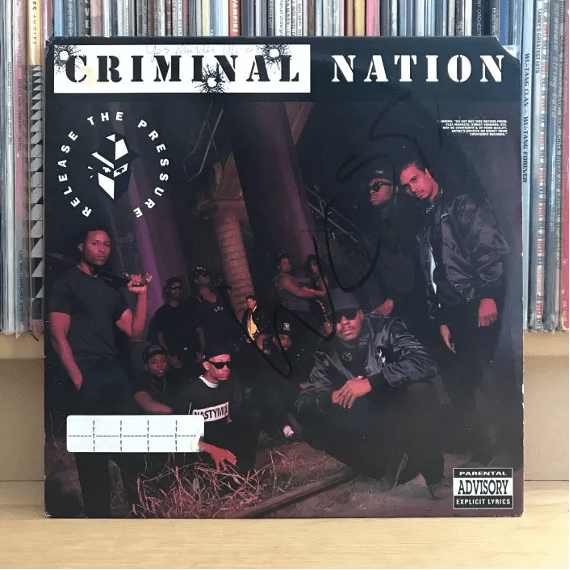
Nasty Mix Records later went on to sign a rap group from Tacoma, Washington to their label. The group was called Criminal Nation; formed by Wojack (MC Deff), consisting of D-Rob, Spade, Bumpy, Wojack, Clee-Bone, Eugenius (DJ E), Pleasant, Simmons, Brown, and Jones, among others. Their first album, “Release the Pressure” was released in 1990, and was mostly created by group members DJ E (Eugenius) and MC Deff (Wojack). Crane City Music (2021) notes that this album was one of the first times that awareness was brought to the violence, drugs, gangs, prostitution, and police brutality that was central to living a life in the Hilltop neighborhood of Tacoma, WA. Their album combines dancing beats and lyrics that bring awareness to Hilltop’s black community. DJ E produced guitar samples and bass lines, while MC Deff raps the lyrics at a terrific speed. Crane City Music notes the drums in this album and how they prompt dancing. They also highlight how MC Deff’s rapping provides this album with uniqueness and DJ E’s simple sampling of guitar pieces contributed to the album’s success.
“Release the Pressure” was the first album in the Pacific Northwest to have a parental advisory sticker due to the graphic content of the music. The members of Criminal Nation were full of anger and passion due to what was occurring on the streets and the negative stereotypes that perpetuated police profiling of the black community. Songs such as “Homocide” and “Criminal Hit” demonstrate their anger and demand for change when rapping about police profiling. Deff made a comment during an interview with the Rocket, “We didn’t make no record to play radio.” Their mission was to spread awareness about the violence within their communities. “Release the Pressure” spent 13 weeks on the Billboard charts. The song “Insane” has an instrumental piece at the beginning, providing opportunity to analyze beat-making and scratching created by DJ-E, and the song uses a fast tempo and funky beats to compliment the lyrics stating that instead of drugs and guns, MC has the mic and love. The song samples beats from other previous songs by black musicians such as “Funky Drummer” by James Brown in the 70s. Their song, “Definitely Down for Trouble” was among Washington’s first references to marijuana within hip-hop music, suggesting that Criminal Nation was raw and brave in challenging social norms and the legal system.
Rap was rising in Tacoma during the early 90s, highlighted by the News Tribune on December 16, 1990. Wojack (MC Deff), stated to interviewers, “the message is for black people to rise up and realize that we are not the enemy. If you look at another black, he’s not the enemy. The real enemy is the drug deal and the Aryan nation.” MC Deff talked about how he spends all of his time rapping about the violence on Hilltop, and the group members saved up $8,000 to create a music video for one of their songs on Release the Pressure album titled, “Black Power Nation.” The video was released in 1991 and features the rap group members chasing a racist white man and threatening to possibly hang him, reversing the power dynamic that has predominated our country since its beginning. Adrien Cheeks, a rap radio host explained that rap is the “Outcast of society used to deliver an important message.”
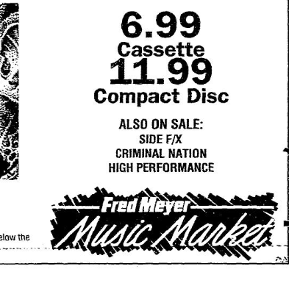
In 1990, the Tacoma Tribune featured Criminal Nation and High Performance, another rap group signed to Nasty Mix Records, showcasing their cassette tapes on sale at the Fred Myer Music Market.
In June of 1999, the News Tribune announced that Criminal Nation would be performing for the first time in their hometown since gaining fame at the La Quinta Inn in Tacoma. Criminal Nation organized a boat party to promote antiviolence and “home-grown hip-hop.” Ten percent of the sales were donated to the Tacoma AI Davies Boys and Girls Club. “It’s up to the people,” said Criminal Nation member Brown, emphasizing that it was up to the people of Tacoma to turn up for the group to get enough support to continue performing. Darren Robinson (D-Rob) told News Tribune, “When we were on stage and we say what we are saying, people feel it and dig us. I think our performance speaks for itself.” Criminal Nation not only brought awareness to the struggles of black youth on Hilltop, but they also brought their live music to Tacoma, and financially contributed to organizations that serve youth.
The Criminal Nation members were not just rappers, they were also active members of their community and cared about each other. The News Tribune published an article on November 21st, 1992 that showcased the group PAAYS (Pay off for Teens), which provided mentors for African American youth in Hilltop, Tacoma. Derrick Pleasant, a member of Criminal Nation, was part of this mentor program. Derrick stated that this program was critical, and he gained connections and a role model through participating with mentors in PAAYS.
In the early 90s, Criminal Nation focused their lyrics on black rights, highlighting violence and struggles that black youth faced. Their second album “Trouble in the Hood,” transitioned to derogatory lyrics about women. In 2000, Criminal Nation issued their third album, Resurrection, returning to their roots of delivering a meaningful message. It draws attention to the negative effects of violence. The purpose of this record was to convey to its young audience that there is another way to live than gangs and violence. Clee-Bone acknowledged that the group didn’t mean to offend women in their second album, saying that, unlike many of the people they grew up with in Hilltop, none of the members of the group are dead or incarcerated. Derrick Pleasant explained how he is a dad of 3 children and plays semipro Football for the Puget Sound Jets. The rappers expressed that music, each of the group members, and their families is what kept them out of the gang world. Although some members left the group to create solo music, their respect for each other remained, and their music and communal actions were influential in bringing rap to Tacoma and recognition to Hilltop (News Tribune, June 18, 1999, p. 72).

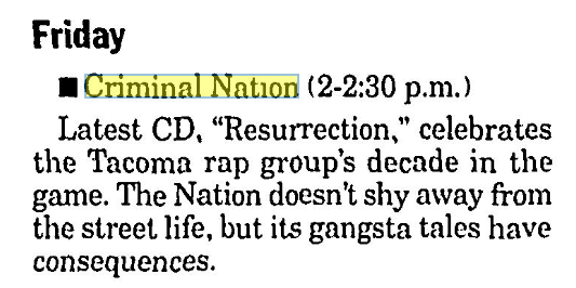
On August 29, 1999 (p. 51), The News Tribune brought recognition to the celebration of Criminal Nation’s 10th anniversary, and also for the release of their newest album Resurrection.
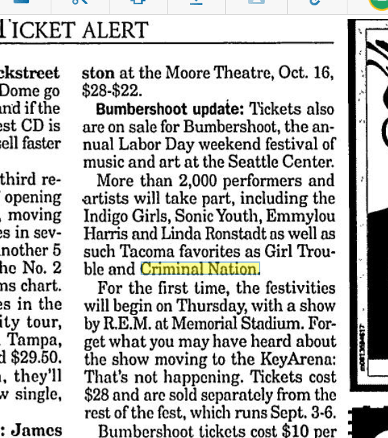
Criminal Nation continued to represent Tacoma and perform in the Pacific Northwest. On August 13, 1999 (p. 50) The News Tribune presented the Bumbershoot yearly Labor Day weekend Festival of Music and Art, taking place at the Seattle Center. The article noted that 2,000 artists were performing at the event, including “Tacoma favorites,” Girl Trouble and Criminal Nation.
About the Author
Meadow Erhardt prepared this article as her final project for TARTS 225: Musical History of Tacoma, taught by Kim Davenport at the University of Washington, Tacoma. At the time she took the class in Autumn Quarter 2023, she was a senior majoring in Psychology.
 Tacoma Music History
Leave a comment