
–by Jaymin Yu
On July 28, 1946, the Point Defiance Park natural amphitheater in Tacoma, Washington, resounded with patriotic songs, jazz, and orchestra. The event was the second USO Music Festival; it attracted more than 7,000 people for a community-oriented celebration of unity and hope for the postwar era. Though the event is a largely forgotten moment in national history, as it stands, it represents one of Tacoma’s most musically varied and symbolically significant collections of concerts and musical performances.
At the utmost center of the festival was the 70-piece Youth Symphony Orchestra of the Pacific Northwest, under the direction of Dr. Francis Aranyi, who delivered one of the more talked about performances of the day. The temporary bandstand–with unfurled flags wrapping around the base–provided the backdrop–complete with patriotic backdrop– which supported the civic and national pride central to the festival’s mission.
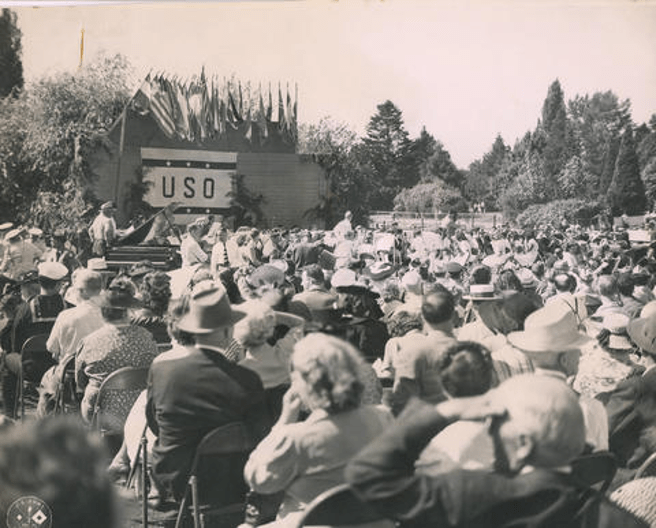
The orchestra’s performance signified much more than musical excellence—it was representative of a generation’s optimism. The orchestra was made up of talented young musicians from around the region, and their participation highlighted the value of youth in the recovery from the war, and their artistic expression as future citizens. They were the sons and daughters of soldiers, students, and immigrants—many had even experienced the impact of the war themselves. Their inclusion in a large civic event highlighted their belief in music as a medium to connect generations and promote peace.
Importantly, this was not merely a local event in itself. The entire concert was broadcast nationally through Mutual Network and locally by KMO. For a single event to be heard across the country highlighted Tacoma’s role in connecting to the broader postwar American narrative and offered significance beyond the regional pride of the performance. Rarely did regional performances receive national broadcasts in 1946. This was a watershed moment in the music history of Tacoma.
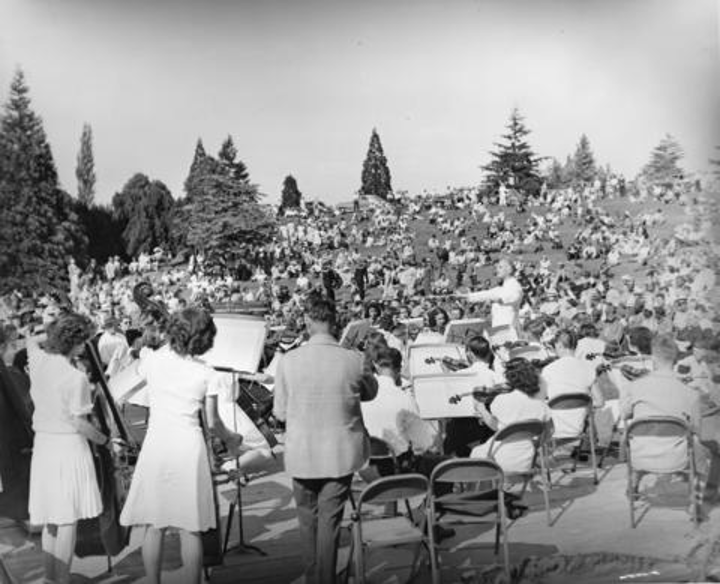
The program was remarkably inclusive; it aggressively included various performers. In addition to the Youth Symphony, listeners heard from the Seattle Elks Band, the Puget Sound Navy Orchestra, the 448th Special Service Band, the jazz ensemble Sharps and Flats led by Joe Jordan, and a vocal act called The Three Dynamos. The musical offerings demonstrated the variety of tastes and multi-cultural makeup of the postwar Pacific Northwest and the USO’s intent to serve all service members.
Most noteworthy is Joe Jordan, a jazz composer and pianist—a musical performer from earlier in the decade in Tacoma’s USO #2, created for the sole purpose of supporting Black servicemen and their families. The Sharps and Flats ensemble, which Jordan conducted, and brought a rich jazz element to the festival, weaving a cultural narrative of musical inclusion together that could transcend the racial segregation of the day. In this sense, the festival displayed Tacoma’s emergence into a larger, accepting cultural identity that would be more diverse musically and civically.
The key role of the USO #2 had already played during WWII, by hosting events for Black soldiers during WWII—integrated music events at a place, which Black soldiers were denied access to any public venue except through the military. The functions the USO #2 would serve would further set the conditions for well-attended and inclusive festivals like this one, where jazz bands, military bands, bands of youth orchestras, of course, would also share the stage without regard to separation. Both military and civilian audiences created a front-row line of musicianship—part professionalism and part community contributions that emphasized music and all its relatable, emotional and gracious inclusivity.
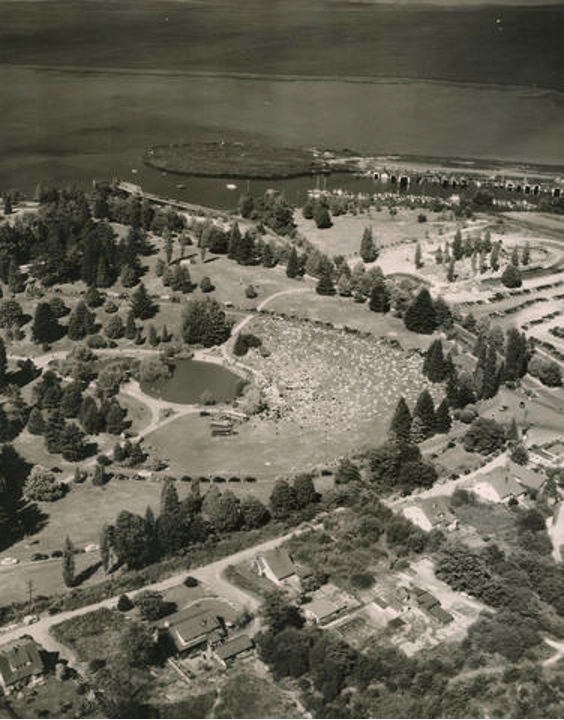
However, even beyond the music, the situation of the festival itself (where the festival took place) is out in the natural amphitheater of Point Defiance Park, and its significance to this event. The publicity and open-air alternative of the outdoor venue freed any sense of accountability to be unnecessarily exclusive at a time when some sort of exclusivity still was normed. Families were gathered discover ably picnicking on the grass; children were observed playing with each other in the background, separated layers of space from various groups surrounding the festival upon waking from WW2, especially the veterans standing side by side the military. This reenacted a moment—a sort of moment—which reincarnated a scene that might parallel some of the simple American democratic values adhered to in the postwar matter.
In terms of logistics, it was a complicated endeavor to set up a large-scale, multi-genre concert to organize in 1946. Contracting the city officials, USO, local radio stations generally, a variety of musicians, and civic volunteers were not easy. If success otherwise denotes civic mindedness, and civic spirit, then we might attest to Tacoma’s civic spirit, in broad belief, to unify the arts as service to the public.
And if we think back to 1946—after we utilize our memories as far if the USO Music Festival symbolizes as it has Tacoma’s performative-identity would influence the postwar American identity of place. It was mainly a local event with national reach, when based on youthful vigor and professional musicianship, that also stood on civic pride. The festival made unity more than a matter of playing melodies.
It is easy now to forget, music festivals were once one thing that cities could project, reflect or imprint their culture onto a national stage before an era of digital communication. Tacoma was able to do that. As we remember the significance of the 1946 USO Music Festival, it allows us to think of music as an independent time capsule, or a bridge across generations and races, long-lived feelings.
Tacoma has an often forgotten sometimes lost music history and the 1946 USO Music Festival is certainly one of its best stories. Not because of any history of romantic grandeur, but because it exemplified Tacoma’s ability to produce and host events only for art that intertwined inclusivity and artistry and civically engaged to have done something well before its time. As we reflect on Tacoma’s music stories, the sounds of the sometimes, those sounds growing ejects about the event and take us back to that summer afternoon one where sounds and music could be useful to bring people together.
About the Author
Jaymin Yu prepared this blog post as the final project for T ARTS 225: Musical History of Tacoma, taught by Professor Kim Davenport at the University of Washington Tacoma in Spring Quarter 2025; at the time, he was a senior majoring in Business Administration (Finance).


Leave a Reply