

— by Emily Gormley
A former professor of what is now Pacific Lutheran University, a musical director for Tacoma Theatre productions, and a Lutheran pastor; Carlo Alberto Sperati (1860-1945) made his mark upon Tacoma through community in equal part to music. Sperati was born in Christiania, Norway (now known as Oslo, Norway) on December 29, 1860, to his father Paolo Sperati and mother, Marie Nielsen. A penchant for music was affirmed from his youth, growing up with a musician father who assumed his own role as the Christiania Theater’s operatic musical director, an organist, and leader of the local military brass band. Besides Carlo Sperati’s own history with music- including proficiencies with the violin, piano, and drums- a young adulthood of sailing propelled Sperati toward the Lutheran ministry abroad. As such, in 1884, Sperati would leave for the United States and enroll in Decorah, Iowa’s Lutheran College to study theology.
Here, his two emerging career focuses would align as he regularly volunteered himself to be a student conductor and part-time instructor for the college, alongside his capacity as a church organist. His contributions to Luther College were so thorough that a full-time faculty instructor had to be hired, supplementing Sperati’s workload when he graduated in 1888. What followed was a position as an organist at the Our Savior’s Lutheran Church, part of the Luther Theological Seminary in St. Paul, Minnesota. Sperati also married a woman from Decorah, Emma Hoffoss, and established his first Norwegian men’s chorus at this time; that being the Nordmaen-gdenes Sangforening. The accumulation of his familiarity with the Lutheran church, instrumentation, choral organization, college-level music instruction, and conducting merged with the propagation of mission parishes across the Pacific Northwest over time, spurring Sperati’s move from St. Paul to Washington State in 1891.

Carlo Sperati began his residence in Washington by serving in various Lutheran congregations throughout the state and would continue to do so until his 1905 return to Decorah, Iowa. Although it was a few years into his stay that Sperati expanded his professional ventures, music stayed at the heart of both his religious teachings and instruction. His first notable position was as an instructor at Pacific Lutheran Academy (now known as Pacific Lutheran University) when the school first was first established in 1894, causing him to leave a pastoral role in Bellingham for a teaching position in Tacoma. As part of Pacific Lutheran Academy’s founding faculty, Sperati created the school’s music department and band program, becoming the school’s first musical director. One of his first acts was to tour the Pacific Lutheran band in his former home of Bellingham. During his tenure, Sperati went onto teach in the religion department as well. He also began serving as pastor at the Tacoma ‘Our Savior’s Lutheran church’ around this time.
A significant feat was carried out in 1896, where Carlo Sperati led his Pacific Lutheran Academy band students up Mount Rainier to the 10,500 foot-level at Camp Muir. Once there, the band had performed the song A Mighty Fortress is Our God. Additionally, Sperati was an early and vocal proponent of calling the mountain by its original name: Tacoma, Tahoma, or Tacobet. Retrospectives after his passing remark on his ‘frequent’ arguments for the utilization of its first name.

Sperati’s choral affinities also resurfaced with his career adopted in Tacoma. He began to lead the Normanna Male Chorus, another Norwegian men’s singing group, after its major reorganization in 1895. This group still operates today under another institution which Sperati explicitly headed, the Pacific Coast Norwegian Singers’ Association (then known as the United Norwegian Singers of the Pacific Coast). This organization, established in Tacoma in 1902, was headed by Sperati until 1916; about ten years after his return to Iowa. This timeframe is also when he developed the Tacoma Oratorio Society, a concert group that allowed Sperati to direct and conduct concerts at the Tacoma Theatre on 9th Street and Broadway. This connection to the theatre district was affirmed by one of his most successful local performances.
In line with his pastoral work, Carlo Sperati led performances of Franz Joseph Haydn’s oratorio: “The Creation”, a celebration of the world’s formation as depicted in the Book of Genesis, on April 17 and 18, 1896. Sperati assumed musical direction for the vocal and symphonic piece while the Tacoma Theatre’s Olof Bull joined as the orchestral conductor, with solo vocalists Mrs. J. Vincent Browne, Mr. Arthur Gower, and Mr. Olaf Udness sporting short biographies alongside the former two in the Tacoma Theatre’s illustrated souvenir programmes. Adorned with an image of 1890s Tacoma from a bird’s eye view on the front and the Tacoma Theatre on the back, this guide given out to all attendees encapsulated the rapid rates of development facing Tacoma as a whole just as it was manifesting in the early Tacoma music scene. The News Tribune looked back on this performance with accolades, describing its success as having garnered an especially ‘large and appreciative audience’ and owing much of that accomplishment to Sperati’s musical direction in tandem with the featured solo vocalists.

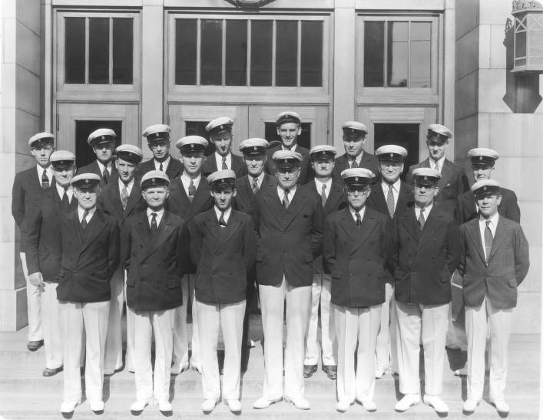
A 1905 offer to become a musical director and professor from Carlo Sperati’s alma mater, Luther College, sent him back to Decorah, Iowa where he would continue to teach for forty years, until his death. However, Sperati’s contributions to Tacoma would remain recurrent. He visited annually, whether with his Luther College band now facilitated for international touring or on his own, until 1915. Sperati regardless continued making visits to Tacoma past this point, especially when touring. His other known years of return were 1921 (60th anniversary tour for the Luther College Concert Band), 1927 (open air concert for the Fourth of July), 1935 (40th annual reunion at the ‘Pacific Lutheran College’, or PLU), and his last visit in 1939 (directing the Norse Male Chorus of Seattle).

Upon Sperati’s 1945 passing, his will had stated that his musical and theological libraries should be dedicated to the then-Pacific Lutheran College in full. Though delayed by probate proceedings attached to the will, their cataloguing at the school was finished in 1951. This final gift to Tacoma, indicative of his decade-long presence from the pivotal role he played in building Pacific Lutheran University’s music department and local independent music groups to his frequent visits even when the Luther College Concert Band transitioned to an international scale, speaks to an especially formative connection. Long after his return to Iowa, Sperati was recorded saying his “heart was in the Northwest”. Aptly, the ‘heart’ in his work can best be seen not only in the institutions he founded or joined, but within the legacy of musical accessibility he promoted through education and the church. The influential combination of community groups, musical program expansion, and the utilization of multipurpose venues in early Tacoma may be reflected in the city’s oldest venues, particularly through the historical churches which originally brought Sperati to the Pacific Northwest.
About the Author
Emily Gormley prepared this blog post as the final project for T ARTS 225: Musical History of Tacoma, taught by Professor Kim Davenport at the University of Washington Tacoma in Spring Quarter 2025; at the time, she was a senior majoring in Politics, Philosophy and Economics.
 Tacoma Music History
Leave a comment